Daily Telegraph chief warns that national newspapers may no longer be sent to NI after Sammy Wilson's libel bill veto http://t.co/9fJZTQnbc9
— Sam McBride (@SJAMcBride) June 29, 2013
Read more here.

Daily Telegraph chief warns that national newspapers may no longer be sent to NI after Sammy Wilson's libel bill veto http://t.co/9fJZTQnbc9
— Sam McBride (@SJAMcBride) June 29, 2013
Daily Telegraph hints at leaving NI over DUP libel reform block. http://t.co/2O2j0DM126Newton Emerson in the tweet above drew my attention to the report that the Daily Telegraph has hinted that it may leave Northern Ireland because of the old libel law regime. Newton Emerson also made an interesting and very Emersonian remark on Twitter: on this occasion, on the DUP's readiness to pursue publishers and social media users for libel damages:
— Newton Emerson (@NewtonEmerson) June 28, 2013

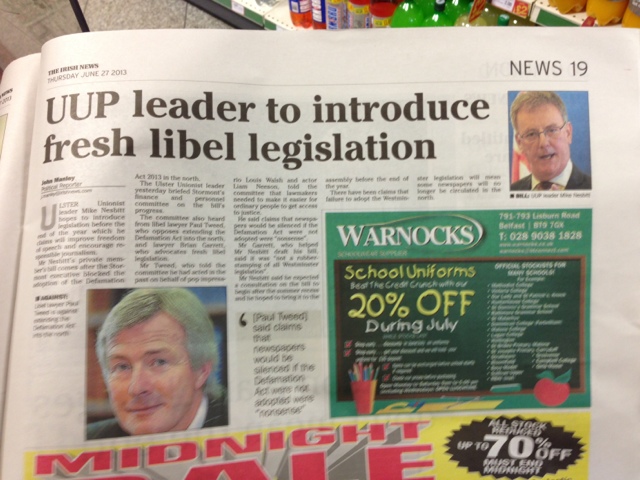 |
| 'UUP leader to introduce fresh libel legislation': headline from Irish News (£), June 27 2013. |

Another lawyer, Brian Garrett, said he did not favour rubber-stamping all Westminster legislation, but there were areas where it should apply and defamation was one of those.
Sinn Fein's Daithi McKay said he was open to the question of whether or not there should be a presumption for trial by jury, and to the possibility of a no-win, no-fee arrangement in defamation cases.A final note from myself that recently came to me: the conditioning of journalism by power is a real and ongoing problem. It’s something Orwell absolutely understood in his 1946 essay, Politics and the English Language. So we need to be very wary.


The CPS have published final guidelines on prosecutions and social media. Please read them carefully: http://t.co/hfCbb2P0Lx
— Jack of Kent (@JackofKent) June 20, 2013
 |
| Barra McGrory QC, Director of the PPS for Northern Ireland |
"Northern Ireland guidelines are currently under development and it is anticipated that these will be published by the end of the summer."When published, the interim guidance document will be accompanied by a period of public consultation. This will then lead on to either, full guidance or new legislation. It is highly unlikely that new law would be produced as there is enough on the statute book to prosecute mis-users as it currently stands.

"It should not have been a flat refusal. The NI assembly should at the very least reconsider halting the extension of libel reform to NI without having a proper, open and public consultation on the issue. There must be an open debate ominous NI about brining it back into line with the rest of the UK.
The press are the eyes and the ears of society and watch as a public watchdog. Chilling press freedom of speech damages the public community at large.

"Unfortunately, the newspaper had failed to show similar concern about the fact that Northern Ireland citizens have for many years been treated differently from their counterparts in the UK in terms of access to the libel Courts. Unlike the position in England, lawyers in Northern Ireland have in the past not been allowed to act on a "no win no fee basis", nor have After the Event (ATE) insurance premiums been recoverable, thereby making it even more difficult for the ordinary man on the street to obtain access to justice.
TUV Leader Jim Allister has established that in the past year a further 2 super injunctions have been issued by the High Court in Belfast.
— Stephen Walker (@StepWalkTV) June 13, 2013
"The growth of ‘super injunctions’ is a product of the courts being persuaded to prioritise privacy rights over freedom of expression and press rights within the Human Rights Act. I am far from convinced that this balance is weighted in the right direction, particularly where it is a facility which in practical terms is only likely to be available to those who can afford it.
Since by their very nature such orders do not sit comfortably with the transparency expectations of modern society, it is, I believe, in the public interest that information about the number and lifting of super injunctions should be known."More information from the BBC of what a super injunction is here and below:

1. Has sectarianism grown new legs through the misuse and abuse of social media? Are there effectively new online interface areas?
2. What is the scale of the challenge posed by social media to the PSNI?
3. My figures obtained under FOI, relating to the number or social media incidents reported to the police, have shown exponential growth since 2010 - the number of prosecutions is also quote high. Therefore I ask, what guidelines are police using before:
i. Responding to reports of misuse and abuse
ii. Making an arrest following said report of misuse and abuse
4. What standard are the prosecution services in Northern Ireland using before deciding to prosecute and individual?
5. What has changed since the February 5 2013 plenary session on social media regulation?
6. Since February 5 2013 have you spoken with either Chris Grayling or Maria Miller?
7. Of the options before you do you lean towards either:
i. Tightening controls such as bringing in censorship measures?
ii. Bringing in new criminal controls as has been suggested by Pat Rabitte for ROI?
iii. Self-regulation and Educating people, especially young people in schools (as per here)?
8. Do you intend to bring forward to Northern Ireland specific guidance for arrests and prosecutions relating to social media - or do you intend to use guidance produced by Keir Starmer (now stepping down from CPS)?I received a response from the Office of the Justice Minister on June 12 2013. None of my questions were actually answered. And I won't have anyone suggest that I didn't ask them as presented above; so below is a screen grab of the original email I sent with relevant addresses redacted.

TWITTER, READ THIS JUDGMENT! 2 men who shared Jamie Bulger killer pics get 9 month sentences suspended for 15 months bailii.org/ew/cases/EWHC/…
— Adam Wagner (@AdamWagner1) June 4, 2013
… Court says in future serious social media injunction breaches, unlikely jail sentences will be suspended. TAKE NOTE bailii.org/ew/cases/EWHC/…
— Adam Wagner (@AdamWagner1) June 4, 2013
High Court judgment in HM Attorney General v Harkins & Liddle (breach of Venables/Thompson injunction) now available bit.ly/13CrlZj
— Judicial Office (@JudiciaryUK) June 4, 2013

Today at 10.30am, ruling of High Court on whether #Bercow's "Why is Lord McAlpine trending? *innocent face*" tweet was defamatory at law.
— Jack of Kent (@JackofKent) May 24, 2013

"In the meantime, vindicated Lord McAlpine’s solicitor sounds a clear and concise note: ‘Mr Tugendhat’s judgment is one of great public interest and provides a warning to, and guidance for, people who use social media."This originally appeared on Twitter for Lawyers here.
"In the meantime, vindicated Lord McAlpine’s solicitor sounds a clear and concise note:
"Mr Tugendhat’s judgment is one of great public interest and provides a warning to, and guidance for, people who use social media."



"I am writing on behalf of the Libel Reform Campaign regarding the Defamation Act 2013. The
Libel Reform Campaign was set up by Index on Censorship, English PEN and Sense About
Science to obtain major changes in the libel laws to better protect free expression.
As you may know, the Minister of Finance and Personnel submitted a paper last May (2013) on adoption of the then Defamation Bill by the Northern Ireland Executive. By June, he had withdrawn the paper and without scrutiny by either the Assembly or the Executive, a decision was made by Mr. Wilson that the Defamation Bill would not be adopted by the Assembly.

"I think social media gives people the opportunity to be foolish in the sense they don’t have to think so much about what they’re saying and the impact of that. How the law applies to social media is something that has had to be looked at in quite some detail in the past year. In England and Wales the Crown Prosecution Service only got to public guidance at the end of last year, 2012. So we’ve taken that guidance.
At the moment what we’re doing is if we get what we think are offences being committed on social media we will report those to the Public Prosecution Service who will make the prosecutorial decisions. And we have prosecuted some people. But for what some people think is offensive, under the law may not be criminal, and that’s that gap. We’ve taken the guidance from England and Wales, the PPS are looking at that here at the moment, and where we do have overt offences we will pursue them but the laws not quite so straightforward as people think it might be."

.jpg)

"It is worthy of note that the Right to Freedom of Expression (Article 10 ECHR) is enshrined in UK law by virtue of The Human Rights Act 1998. Whilst this is not an absolute right the threshold to be reached for a prosecution is a high one.
In recognition of the complexity of Social Media-based criminality, the Director of Public Prosecutions (DPP) for England and Wales, Keir Starmer, QC has issued interim guidance via the CPS. This guidance forms part of an ongoing consultation process on the future approach to tackling Social Media-based criminality.
The DPP is recognised as a leading authority in Human Rights Law and was previously a Human Rights Advisor to the Policing Board.
Within Northern Ireland the Public Prosecution Service (PPS) has not yet adopted formal guidance of their own, however they are content for the PSNI to work to that issued by the DPP.
Social Media related incidents/crimes are relatively new so there is presently an inconsistent approach to the recording of same on police systems. Whilst a number of cases have been referred to the PPS none have reached the threshold for prosecution. We will of course continue to work closely with the PPS in respect of such matters and refer individual cases as and when all investigative strands are complete.
Moving forward, and to return to the specific points within your question, discussions have taken place around identifying steps to enable some method to enable us to easily identify social media offences so to allow for details to be more easily captured/interrogated. However, at this stage work in this area has yet to commence."Read the communication with Matt Bagott in full here.

You’d be forgiven for thinking one who does would be working behind a mahogany desk in a palatial office in Los Angeles or London, his every call screened by an army of assistants.
Instead, Paul Tweed, the senior partner of Johnsons Solicitors, works from a functional building on Belfast’s Wellington Place, which, on the unusually hot day I meet him, has the windows wide open to the traffic noise below to keep cool. His direct line rings at regular intervals. He pours his own coffee. And the desk is so covered in papers I can’t guess what it’s made of, but I’d bet its not mahogany.


